At the Table

At the table, between two arts of living

Vin Jaune was born at the French table. Great chefs placed it at the heart of dishes that became classics. We set them in conversation with Japanese cuisine and the Japanese art of the table.

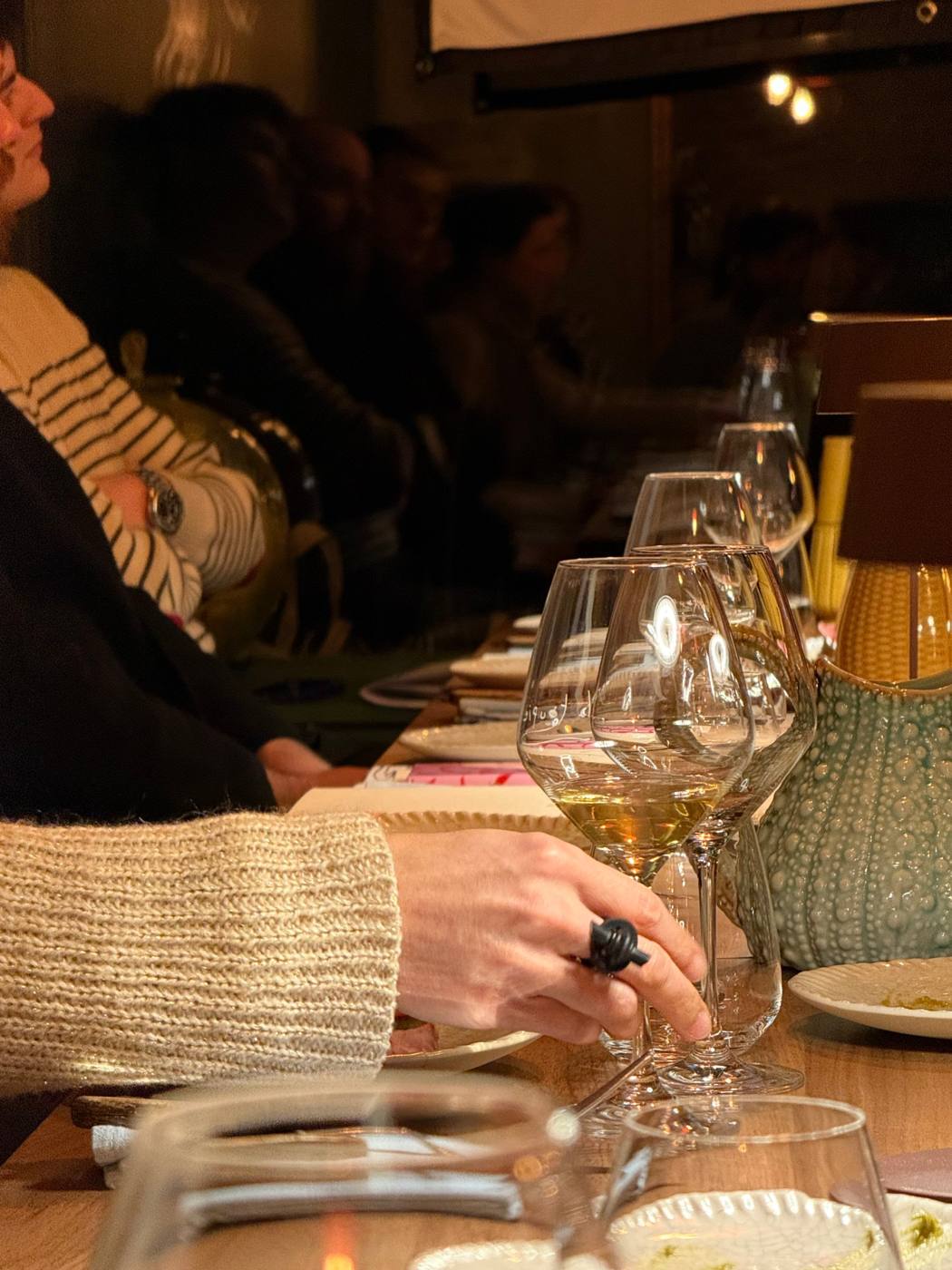
A Vin Jaune tasting around a long table

Bresse poularde, Vin Jaune and morels

The classic
The great classic of the Jura. Jean-Paul Jeunet, two Michelin stars in Arbois, lifted it with massala spices; Romuald Fassenet, Meilleur Ouvrier de France and starred chef at Château Mont-Joly, has his own version too. Before them, Paul Bocuse made the fricassée of Bresse chicken with morels a classic, the bird gently cooked in its broth rather than seared.
At the table
Served in a lidded lacquer bowl (owan): lifting the lid is like lifting a cloche, and the scent of Vin Jaune arrives first.

Chanterelles with Vin Jaune

The classic
Yannick Alléno, three stars at Pavillon Ledoyen in Paris, makes a cassolette of chanterelles lifted with a dash of Vin Jaune. The same chef has opened a sushi counter in Osaka.
At the table
The French cassolette and the Japanese dobin share one purpose: to hold the aroma until the very last moment.

Chicken royale with morels

The classic
Jean-Paul Jeunet served a chicken consommé with royale and morels. A royale is the delicate set custard of classic French cooking.
At the table
Served in a lidded cup and eaten with a spoon: the gesture is the same in Arbois and in Kyoto.

Apple with spiced Vin Jaune

The classic
For dessert, Jean-Paul Jeunet worked apple with spiced Vin Jaune: jelly, sorbet and a soft walnut biscuit.
At the table
Plated on raw ceramic, the Japanese way, yet served at the end of the meal like a French dessert.

Comté and Vin Jaune

The classic
The Jura’s reference pairing: aged Comté and Vin Jaune share the same walnut notes. The Jura wine board even suggests it as an aperitif, with simple cubes of cheese.
At the table
The cheese board becomes a hassun: each element in its place, with space around it.

Morels with cream and Vin Jaune

The classic
Jacques Barnachon, a starred chef, published his ragout of morels with cream and Vin Jaune, emulsified at the last moment to keep the wine’s aroma.
At the table
The steaming cassolette on the French side; on the Japanese side, a long, narrow plate (yakimono-zara) where the morels line up like skewers.

The Japanese echoes are Sous Voile’s own suggestions, inspired by these classics. The original recipes belong to their chefs.

Two arts of the table in dialogue

Two meals recognised by UNESCO

The gastronomic meal of the French (2010) and Japanese washoku (2013) are both inscribed as intangible cultural heritage of humanity. Two cultures that eat with the eyes, and with time.

The menu and kaiseki

On one side, the order of starter, main, cheese and dessert; on the other, a sequence of small dishes paced by the season. Vin Jaune holds the high point: the cream-based dish or the cheese.

Crystal and ceramics

France lines up matching glasses; Japan chooses each bowl for its season. We suggest both: a fine tulip glass for the Vin Jaune, varied ceramics for the dishes.

The white tablecloth and ma

The French table loves order and symmetry; the Japanese table lets the empty space between objects breathe, the ma. A single clavelin at the centre, undecorated, brings the two together.

The right moment

Vin Jaune waits six years and three months; Japanese cuisine waits for shun, the exact moment of the season. Serving Vin Jaune at 15–17 °C, opened a few hours ahead, honours that time.

A molecule in common

Sotolon, with its notes of walnut and curry, was first identified in aged sake by Japanese researchers in the 1970s. It is also one of the aromatic signatures of Vin Jaune.